ServicesCommercial Roof Repair
Commercial Roof Repair in Blanchard, OK
Water dripping through an office ceiling tile has usually traveled along the deck from somewhere else. We find the actual opening at a seam, flashing or drain, fix that point properly and tell you plainly whether the rest of the membrane still has years left in it.
Repairing the Spot That Failed, Not the Entire Roof
A handful of places account for most commercial leaks: lap seams that have separated, flashing at rooftop units and pipe penetrations, parapet walls and coping, and drains or scuppers that hold water. On a low-slope roof, water moves sideways beneath the membrane and along the deck until it finds an opening, so the stained ceiling tile can sit 20 feet from the real hole.
When the membrane and insulation are still in good shape, we repair. If cores turn up wet insulation over wide areas, or the membrane has shrunk and split in many spots, we tell you and explain why our commercial roof replacement work would save you money over a roof that keeps needing patches.
The repair is done under our Oklahoma commercial roofing license and Oklahoma general contractor license, the credentials this kind of work requires.
What Our Commercial Repairs Include
- Tracing the leak from above
- With your list of interior leak spots, we walk the roof and examine the seams, terminations and penetrations uphill of each one. We probe questionable areas and, when needed, cut a core to find out if the insulation below is wet.
- Membrane and seam fixes
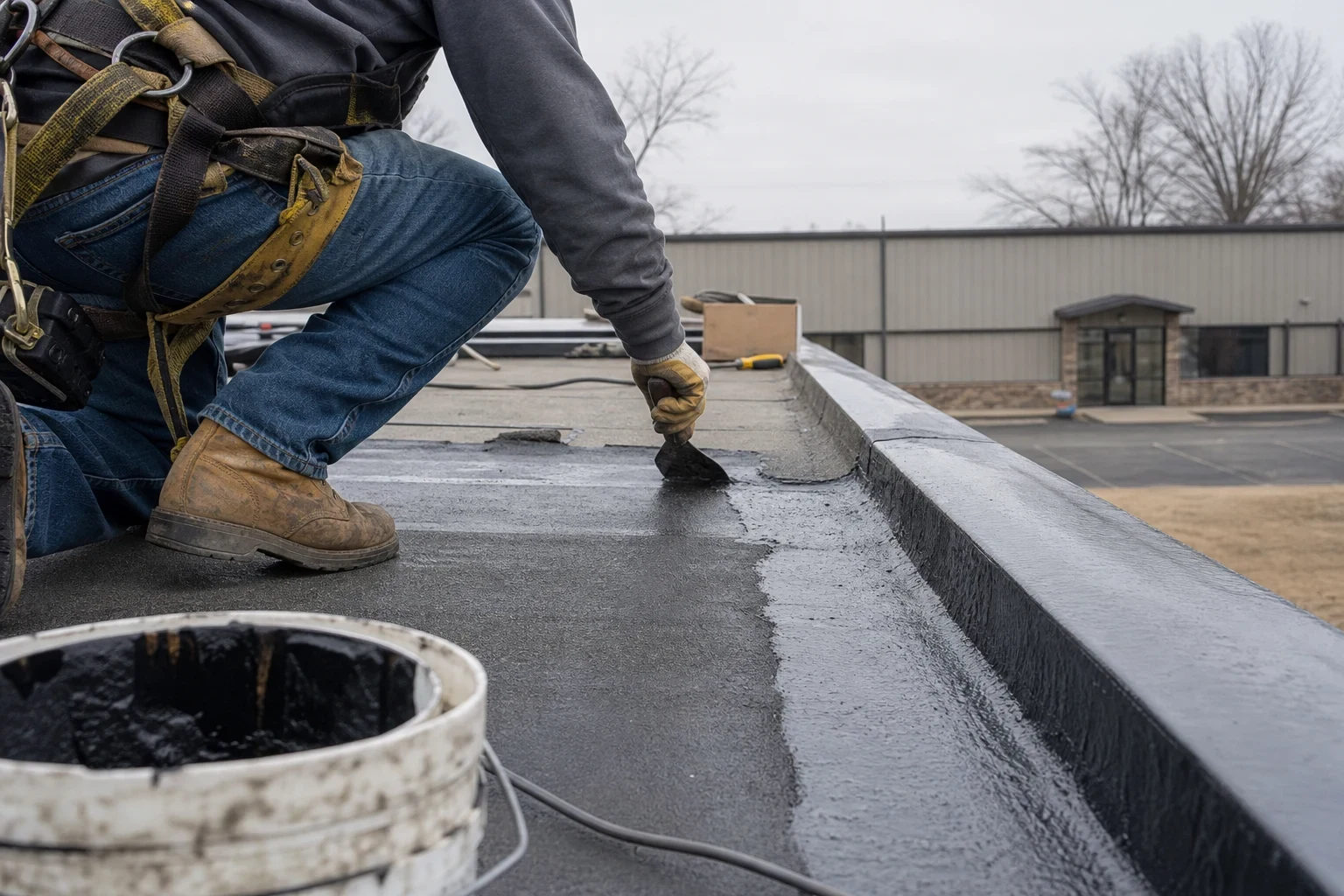
- For TPO, we clean the surface and heat-weld fresh membrane across open seams. For EPDM, we apply primer with seam tape or cured cover strips. On modified bitumen and built-up roofs, we use matching torch-down, cold-applied or hot-mopped plies so the patch bonds to what is already there.
- Flashing at curbs, pipes and parapets
- HVAC curbs, exhaust fans, plumbing vents and pitch pans shift with heat and vibration, so their flashing often gives out first. We reflash them with materials that suit your membrane and reset or replace loose coping and counterflashing along parapets.
- Drains, scuppers and low spots
- Blocked drain baskets and scuppers that are too small leave ponding water that wears down seams and loads the deck. We clear and reseal drains and correct low spots with tapered insulation or crickets when the area is small enough for a repair.
- Metal panel repairs
- On metal buildings, we replace fasteners that have backed out or worn, reseal laps and ridge caps, and treat rust at the panel ends before it goes past the surface.
- A written scope with photos
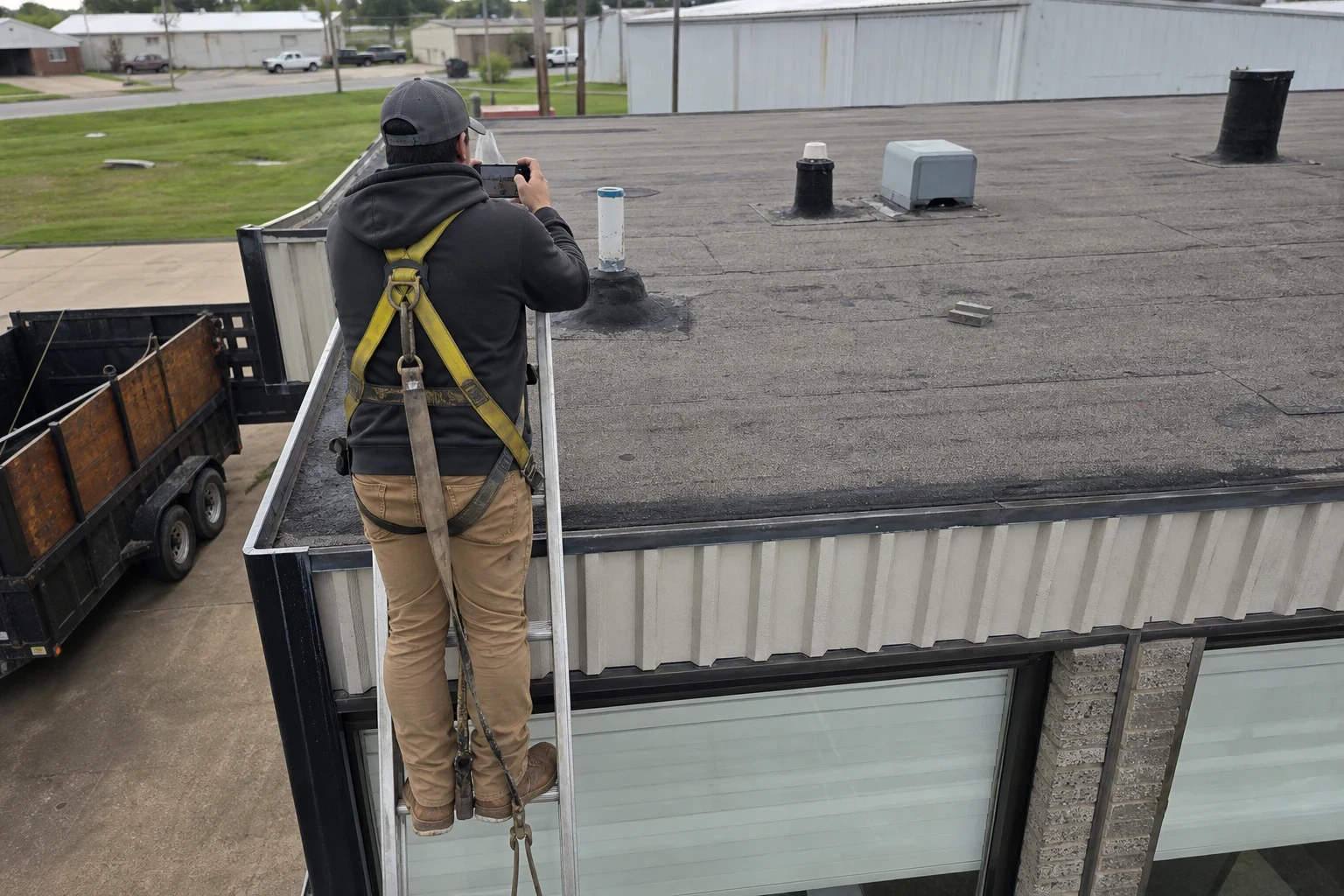
- We give you photos of our findings and an itemized description of the repair, so the owner, tenant or property manager sees exactly what we saw.
Warning Signs on a Commercial Roof
Ceiling tiles stained or sagging
Brown rings on acoustic tile show water has been getting to the deck for some time. A sagging tile has soaked through and is carrying extra weight.
Ponding that lasts 48 hours
Water that sits two days or longer points to a clogged drain or a sagging deck. If ignored, it hastens seam failure and wears down the membrane.
Open laps, ridges or blisters
On modified bitumen and built-up roofs, blisters hold moisture between the plies. On single-ply roofs, an open lap gives water a straight path in.
Membrane pulling from walls
As single-ply membranes age in the heat, they shrink and tug at the base of parapets and curbs. That pull rips flashing and opens the edge.
Punctures or hail bruises
Oklahoma hail can crack brittle membrane and dent metal panels. Technicians walking to HVAC units also leave cuts in the roof around the equipment.
What Moves the Cost of a Commercial Repair
We price repairs from what we find on the roof, not from square footage alone. You get the scope in writing ahead of any work, and if we uncover wet insulation or damaged deck once the membrane is opened, we stop and show you first.
Roof system and its age
Heat-welding new TPO to aged, chalky TPO takes more surface prep. Older built-up roofs need hot or cold-applied plies that match the existing layers.
Extent of wet insulation
Saturated polyiso or fiberboard has to be cut out and replaced, since it no longer insulates and holds water against the deck.
Number of penetrations
A roof with many curbs, vents and conduit runs has more flashing to rework than an open field of membrane.
Access and height
Interior roof hatches, tall parapets or the need for a lift change labor time and equipment.
Deck condition
Rusted steel deck or soft wood sheathing found under the membrane must be repaired so the new roof surface has a solid base.
How a Repair Visit Runs
- 1
Phone conversation first
You tell us the roof type if you know it, where the leaks show inside and how the roof is accessed. We schedule a visit around your business hours.
- 2
Roof assessment
We inspect the surface, seams, flashing and drainage and cut cores where moisture is suspected. Cores are patched the same visit.
- 3
Repair or replace answer
We walk you through the photos and explain what is failing and why. If repair makes sense, you get a written scope. If it does not, we explain what replacement would involve.
- 4
The repair
Crews work from the roof with ladder or hatch access, keep material staged away from entrances and protect landscaping and parking areas below. Most repairs do not interrupt work inside the building.
- 5
Cleanup and water test
We remove debris, clear drains and, where practical, water-test the repaired area so you know it holds when the next rain comes.
Commercial Roof Repair Questions
How do you choose between patching the membrane and tearing it off?
If water enters at a few separate seams, flashings or drains and the insulation below is mostly dry, a targeted repair usually gives you more for the money. If cores find moisture across big sections, or the membrane has gone brittle and is splitting all over the field, repairs become a bill that keeps coming back. We set the cores and photos in front of you so the decision rests on what the roof shows.
Will the repair get in the way of my business?
Almost all of the work is done on the roof, not inside the building. Torch-applied or hot-mopped materials can push some odor toward rooftop air intakes, so we plan around your HVAC and business hours. We agree on access, parking and where materials go before the crew arrives.
What Oklahoma licenses apply to your commercial work?
We do commercial roofing under an Oklahoma commercial roofing license and an Oklahoma general contractor license. For roofs on homes, we also hold an Oklahoma residential roofing license.
Our building took hail. Can you help with the insurance claim?
We document the hail damage with photos and measurements and write a repair scope you can send to your carrier. The adjuster makes the coverage decision, not us. If you want, we can meet the adjuster on the roof and show the damage we recorded. Our storm damage repair page covers the process in more depth.
Can a roof coating stop our leaks?
On a dry, structurally sound roof, a coating can buy years of life. Put over wet insulation, it traps the moisture and hides the actual problem. We check for moisture first and tell you plainly whether a coating fits your roof.
Do you repair commercial roofs outside Blanchard?
We do. Besides Blanchard, we take commercial repair jobs in nearby towns such as Newcastle, Tuttle, Moore, Mustang, Goldsby, Noble and Chickasha.
Have the Leak Found and Repaired
Let us know where the water appears and what type of roof the building has. We will book a time to check it and walk you through what the repair takes.