ServicesRoof Inspections
Roof Inspections in Blanchard
We walk your roof, check every part that keeps water out and show you photos of what we find. Then we tell you plainly whether a targeted repair will do the job, or whether the roof has reached the point where replacement is the better use of your money.
What you learn from a roof inspection
Roof trouble usually begins with something minor: a shingle tab that lifted, a pipe boot that cracked, a nail working loose from the deck. Ignored, each one lets water into the felt and then the plywood, and that is where costs climb. An inspection catches those spots before they turn into a ceiling stain.
We are after a true picture of your roof, not a sale. When a few new shingles and resealed flashing will keep the roof going for years, we recommend exactly that. When the granules are worn off, the mat is brittle and the decking is soft in several spots, we explain why a patch would last only a season and show you what we found.
With an Oklahoma residential roofing license and an Oklahoma general contractor license, the person looking at your roof can also repair what he finds, not just report it.
Parts of the roof we examine
Shingle field and adhesive strips
We check for bald spots where granules have worn off, plus cracks, curled edges, blisters and tabs that have let go of their adhesive. Wind catches loose tabs first, so we lift-test them by hand along the eaves and ridge lines.
Flashing and roof penetrations
Step flashing along sidewalls, counterflashing at the chimney, valley metal, plumbing vent boots and exhaust caps all get a close look. These transitions leak far more often than open shingle areas, usually because sealant has dried out or a rubber boot has split.
Deck boards and nails
Walking each slope lets us feel for spongy areas that point to wet or delaminating plywood underneath. We also mark nail pops, where a fastener has worked up through the shingle and opened a route for water.
Attic and airflow
If the attic is reachable, we inspect the underside of the deck for water stains, pinholes of daylight and mold, and confirm the intake and exhaust vents are really circulating air. A poorly vented attic cooks shingles from underneath and cuts years off their service life.
Gutters and runoff
We confirm the gutters slope toward the downspouts, the hangers are secure and granules are not piling up in the troughs. When water backs up at the roof edge, it rots the fascia and the lowest row of decking. Our gutters page goes into that work.
Signs it is time for an inspection
Hail or strong wind just hit
A hailstone can fracture the shingle mat without punching a visible hole. Spring storms in central Oklahoma regularly leave damage that cannot be seen from the ground, and it is easier to document while the event is recent.
Gutters full of granules
A brand-new roof sheds some loose granules, and that is expected. On a roof with years behind it, thick drifts of granules mean the asphalt underneath is losing its UV shield and wearing out faster.
Stains on a ceiling or attic framing
The stain you see is seldom right below the entry point. Water travels along the felt and down rafters before it drips, so we trace the source from the roof side.
A house sale is coming up
Buyer or seller, a written roof report puts the condition and expected remaining life on record before anyone agrees on a price.
Your roof is over 15 years old
Heat and time make asphalt shingles stiff and brittle. A check at this age tells you whether to start setting money aside for replacement or keep up with maintenance on the roof you have.
How the inspection works
- 1
Phone call
You tell us the age of the roof, any leaks and anything that prompted the call. We set a time that works for you.
- 2
Ground and exterior check
We start from the yard, looking at the roof lines for sagging, the gutters, fascia and soffit. This shows us where to focus once we are up top.
- 3
On the roof
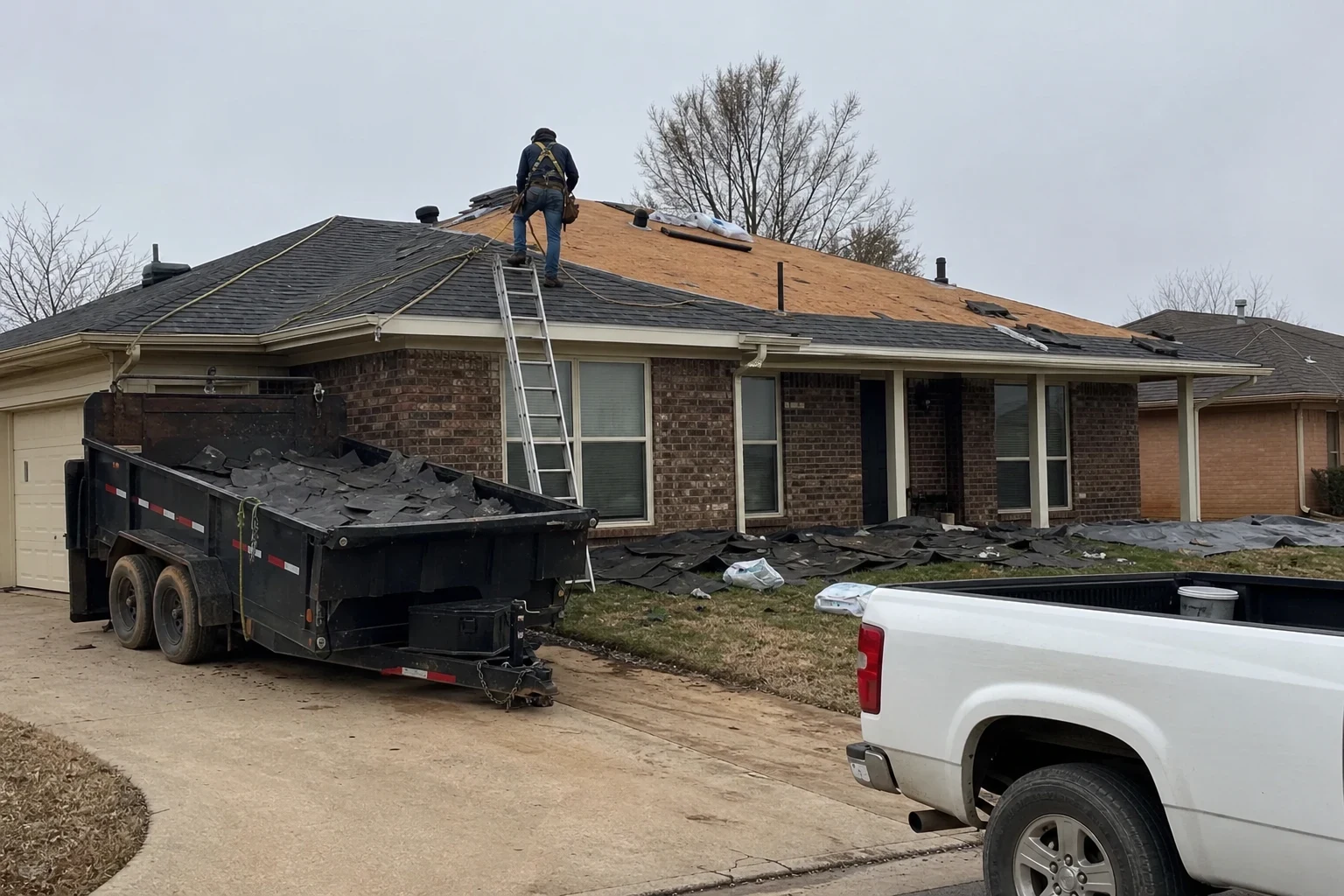
We walk the slopes where it is safe to do so, checking shingles, flashing, vents and decking, and photograph each problem with something in frame for scale.
- 4
Attic look, if accessible
From inside we confirm or rule out leaks and check ventilation and insulation around the roof deck.
- 5
Your answer
We go through the photos with you and give a straight recommendation: no work needed, a specific repair, or replacement, along with the reasons. If you need work, we explain what it involves and write up the scope.
What changes the price of an inspection
An inspection costs less than a repair, but no two houses take the same visit. The price shifts with how long we spend on the roof and how much we need to record. On the phone, we let you know what to expect before we arrive.
- Roof size and pitch
- Steep or multi-level roofs take more time to cover safely and can call for added fall protection.
- Number of penetrations
- Each chimney, skylight, dormer and vent adds flashing joints we need to check and photograph.
- Attic access
- An attic we can walk through gives us a helpful extra look. A small scuttle opening or blown-in insulation can block part of the view.
- Purpose of the report
- A report for a home sale or a storm damage write-up for an insurer needs more records than a routine check.
Roof inspection questions
Something not covered here? (405) 477-4813
How long does an inspection take?
Plan on roughly an hour for a typical house. A big footprint, a steep pitch or an attic check can stretch that. You never need to climb up with us, but we prefer to sit down with you afterward and walk through the photos together.
Will you just tell me I need a new roof?
No. When a repair will hold, we recommend the repair, since it usually gives you more for your money. If replacement is the better call, we show you the evidence, such as soft decking across several slopes or shingles that snap instead of flex.
Can you help after hail damage?
Yes. We photograph hail strikes and wind-creased tabs so you have a record to share with your insurance company. We walk you through what we found, but coverage is the adjuster's decision. The repair side is covered on our storm damage repair page.
Do you inspect commercial roofs too?
Yes. Our Oklahoma commercial roofing license lets us evaluate low-slope and other commercial roofs. What we find there carries straight into our commercial roof repair and commercial roof replacement work.
How often should my roof be inspected?
A yearly check is a good baseline, with an extra look after any serious hail or wind event. On an older roof, spring is the best time, because damage from winter freeze and thaw cycles is easiest to see then.
Get a clear read on your roof before you spend on it
We photograph each problem, explain what caused it and tell you whether a repair will hold or replacement is the smarter spend. We work in Blanchard and in nearby towns such as Newcastle, Tuttle and Moore.